





NANO Health Products · Kingdom of Saudi Arabia
NANO AR-DRG for Saudi Arabia
Code it right the first time — and get paid for the care you actually delivered.
NANO AR-DRG groups every admitted and daycare episode to AR-DRG Version 9.0, the version in force in the Kingdom, then checks the coded record against the Saudi Billing System before it reaches NPHIES — so a rejection is still a correction.
AR-DRG V9.0ICD-10-AM · ACHI · ACS Tenth EditionSBS V2.0 & V3.0NPHIES-readyIHACPA-licensed grouperArabic and EnglishREST API into your HIS
24-hour go-live
Start now — go live in under 24 hours.
Your first episodes grouped to AR-DRG V9.0 and shadow-billed beside your current system — no downtime, no rip-and-replace.
Funded by NANO Health
Your onboarding is on us — prove the recovered revenue before you invest.
- CDI 360 · AI clinical documentation
- Shadow Billing · actual vs. optimal DRG
- HIS Integration · into your existing system
We cover the setup; you keep the numbers you can see.
Built to the standards your claims are judged against
AR-DRG Version 9.0
The version used in the Kingdom for reporting all admitted care, inpatient and daycare.
ICD-10-AM · ACHI · ACS
Tenth Edition — the diagnosis, intervention and coding-rule standards mandated across Saudi Arabia since January 2020.
Saudi Billing System
SBS V2.0 and V3.0 maintained in parallel, with crosswalks to ACHI and CPT rather than a one-way migration.
NPHIES
Codes validated and mapped before submission, because NPHIES refuses an invalid code at the door.
IHACPA-accredited
Licensed to develop and distribute the Australian Refined Diagnosis Related Groups classification.
MDC · ADRG · PCCL
The whole grouping path is visible — not a final code with no reasoning attached.
The problem
Four ways a correctly delivered episode still loses money
None of these are clinical failures. Every one of them happens after the care is finished, in the gap between what the record says and what the claim can prove.
01
Rejected before anyone reads it
NPHIES validates a submission when it arrives, not at adjudication. An invalid or unmapped code is not a slow payment — it is a zero, and it stays a zero until somebody finds it, corrects it and resubmits.
02
A billing standard that moves underneath you
SBS V2.0 and V3.0 are both in circulation. A crosswalk that lags a version turns clean claims into rejections overnight, across every affected service line at once.
03
Severity that never reaches the claim
A comorbidity recorded in the notes but missing from the coded record moves the episode into a lower severity partition. Same patient, same work performed, lower cost weight.
04
An audit you cannot answer with data
Coding accuracy is a leading trigger in payer audit. Without a trail showing which standard drove which decision, a review becomes an argument instead of a reconciliation.
How it works


Three tools working on one coded record
Intelligent Coding Wizard
Lead-term search, index-to-tabular verification and the Australian Coding Standard that governs the decision — surfaced at the point of doubt instead of buried in a manual.
- ICD-10-AM, ACHI and ACS Tenth Edition content with the reference notes attached to the code rather than filed away from it
- Coding-convention guidance, so the lead term and the correct coding pathway stay in view while the decision is made
- Classification rules, errata and updates maintained centrally, so no coder works from a superseded rule and nothing has to be re-coded later
- Available per coder or per team, for a single hospital or for a network
Intelligent Grouper
Groups the episode to AR-DRG Version 9.0 and shows the whole path — Major Diagnostic Category, adjacent DRG, severity partition and the PCCL behind it — so a coder can see why an episode landed where it did.
- Immediate access to every supported AR-DRG version and clinical score from one screen
- The cost consequence of a complication is visible while the episode is still being coded, not a month later in a variance report
- Grouping rationale retained with the episode, so a coding decision can be reconstructed when it is questioned
- Access controls and data protection applied across every layer of the platform
Batch and Bundle Grouper
A console built for volume: analyse, validate, differentiate and group whole populations of episodes in a single pass.
- Up to one million transactions per batch, by file upload or API integration
- Uploads of up to 300 MB, with national and international code sets searchable in detail
- Runs stand-alone to determine the best-matched AR-DRG version for a dataset
- Suited to regulators, government entities, third-party administrators and multi-site hospital groups processing very large record sets
See it in the coder's screen
One workspace, from the code to the group to the claim
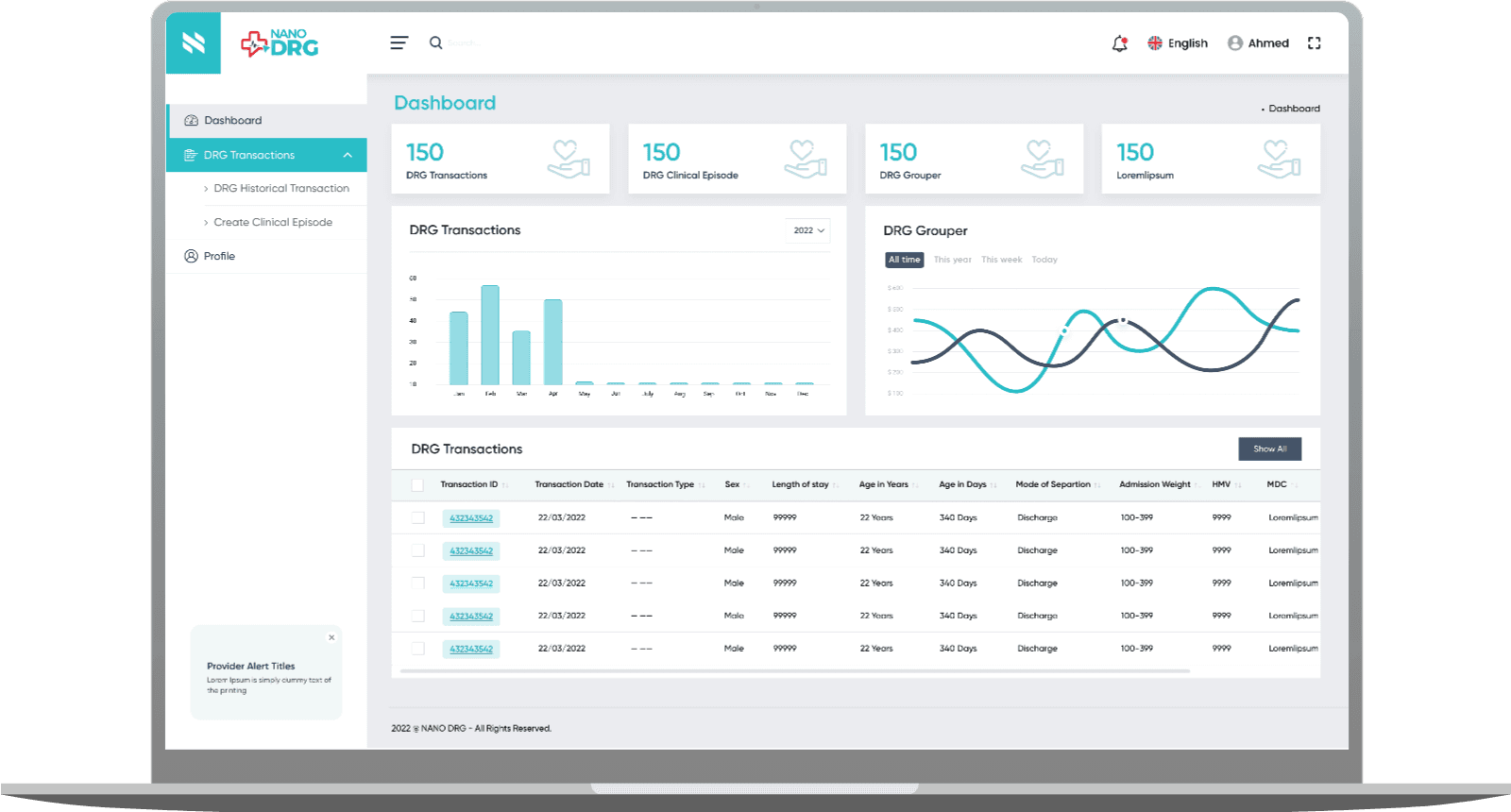
Coders work in one place: search a lead term, verify it against the tabular list, watch the episode group to its AR-DRG, and see the cost weight and the validation result before anything is submitted. No switching between a coding tool, a grouper and a claim system.
The coding pathway and the resulting AR-DRG on the same screenSeverity partition and PCCL shown, not just a final codeSBS and NPHIES validation surfaced before submission
Why documentation specificity decides the payment
Same patient. Same care. Two different cost weights.
AR-DRG places each episode in a Major Diagnostic Category, then in an adjacent DRG, then in a severity partition determined by the Patient Clinical Complexity Level (PCCL) that the coded diagnoses produce. When a documented comorbidity never reaches the coded record, the episode falls into a lower partition — and the cost weight falls with it.
Comorbidity documented in the notes, absent from the coded record
1.84
cost weight
Lower severity partition
Comorbidity captured in the coded record and supported by the documentation
3.57
cost weight
Higher severity partition
Across a year of discharges, that difference is precisely what the Case Mix Index measures: the sum of the cost weights of every episode, divided by the number of episodes. A hospital sitting below its expected Case Mix Index usually has a documentation gap rather than a less complex patient population.
Illustrative, using published AR-DRG cost weights. The objective is to capture the severity already present in the clinical record and to defend it under audit — never to influence how care is documented or to change a clinical judgement.
Capabilities
What the platform does day to day
Coding help at the point of doubt
Lead-term search, coding-standard guidance and reference notes attached to the code — so the decision is made once, correctly, without leaving the screen.
Rules checked before submission
A medical rules engine validates code validity, medical necessity and age and sex edits against ICD-10-AM, ACHI, SBS and CPT while the claim can still be corrected.
One record, one platform
Grouping works from the same episode as clinical decision support and the electronic medical record, so coders and clinicians are not reconciling two versions of the truth.
Into your HIS, not beside it
REST API integration with the hospital information system you already run. Episodes group where they are created, with no parallel data entry for coders to keep in sync.
No rip-and-replace
Designed to work with the software your teams use today, so adoption is a configuration exercise rather than a migration project.
Planning and epidemiology
Maintained against the international statistical classification of diseases, so the same coded data supports service planning and population-level reporting.
Volume without a queue
Up to one million transactions per batch and uploads of up to 300 MB, so retrospective review of a full year does not need a project team.
Reporting you can defend
Collect, validate, analyse and report coded activity in the form your regulator and your payers ask for, with the reasoning behind each assignment retained.
For your team
What each stakeholder needs to know
Chief Financial Officer
Which line does this move, and when?
Denials first, because that is where cash returns fastest, then realised revenue per case as severity capture improves. Case Mix Index is how the second is measured — it is not the objective, and it should never be managed as one.
Coding and HIM Manager
Will my coders trust it?
It works in ICD-10-AM, ACHI and ACS Tenth Edition, groups to AR-DRG Version 9.0, and shows the Major Diagnostic Category, adjacent DRG and PCCL behind every assignment instead of returning a code with no reasoning.
Revenue Cycle Director
Where does a rejection get stopped?
Before submission. Codes are validated and mapped across SBS V2.0 and V3.0 while the claim is still yours to correct, rather than after NPHIES has returned it and the clock has restarted.
IT and Integration
What do we actually have to change?
A REST API into the systems you already run, plus batch upload for retrospective work. There is no requirement to replace the clinical software around it.
Beyond reimbursement
What Diagnosis Related Group data is used for
Activity-based classification was built for funding, but the coded dataset it produces answers questions no billing system can.
- Performance management across service lines, sites and clinicians
- Facilitating payment of services in the private healthcare sector
- Benchmarking against comparable providers, and coder education
- Epidemiology and population health reporting
- Research into quality of care and patient safety
- Health service planning and capacity decisions
Frequently asked questions
What is AR-DRG, and how does it differ from other DRG systems?
- AR-DRG — Australian Refined Diagnosis Related Groups — classifies each admitted episode into a group of clinically similar cases that consume similar resources. It is built on ICD-10-AM diagnoses and ACHI interventions, and its severity model runs through the Patient Clinical Complexity Level (PCCL), derived from the complexity levels of the coded diagnoses. That is a different mechanism from the complication and comorbidity flags used in the American classification, so severity logic learned on the US system does not transfer directly.
Which AR-DRG version applies in Saudi Arabia?
- AR-DRG Version 9.0 is the version used in the Kingdom for reporting all admitted care encounters, covering both inpatient and daycare episodes. Later versions exist internationally — Australia itself has moved on to newer releases — but a Saudi provider is measured against V9.0. NANO AR-DRG groups to V9.0 today, with newer versions supported as the Council of Health Insurance adopts them.
What is the Saudi Billing System, and how does it relate to ACHI?
- The Saudi Billing System (SBS) is an expansion and modification of the Australian Classification of Health Interventions, developed for the Saudi health insurance market and now a standard billing requirement for NPHIES. Versions 2.0 and 3.0 are both in circulation, which is why crosswalks between SBS, ACHI and CPT have to be maintained side by side rather than migrated once and forgotten.
How does this help prevent NPHIES rejections?
- NPHIES validates a submission at the point it is received rather than at adjudication, so an invalid or unmapped code is refused immediately and nothing is paid until it is fixed. NANO AR-DRG runs code validity, mapping and medical rules checks before the claim leaves your building, which turns a rejection into a correction while it is still cheap.
What is Case Mix Index, and what actually moves it?
- Case Mix Index is the sum of the cost weights of all your episodes divided by the number of episodes — one number describing how complex the casemix you treated actually was. It moves when the coded record more completely reflects the severity that clinicians already documented. It is a measurement of documentation and coding completeness, and treating it as a target in its own right is a compliance risk rather than a revenue strategy.
Do we have to replace our hospital information system?
- No. NANO AR-DRG integrates through a REST API with the hospital information system you already run, and can also work from batch file upload for retrospective review. It is built to sit alongside existing clinical software rather than to displace it.
Does the platform work in Arabic?
- Yes — the platform is used in Arabic and in English. That matters in Saudi Arabia, where clinical documentation, coding teams and payer correspondence are rarely conducted in a single language.
How large a dataset can it process at once?
- The batch and bundle grouper handles up to one million transactions per batch, with uploads of up to 300 MB, by file or through API integration. It is used by regulators and large commercial organisations as well as by individual hospitals and daycare centres.
NANO Health Suite
30
Countries covered
22
Years in service
07
Regulators in MENA
30
Fully automated modules
NANO Health Suite is an accredited licensee of the Independent Health and Aged Care Pricing Authority (IHACPA) for the Australian Refined Diagnosis Related Groups classification, distributing grouper versions built on ICD-10-AM.
See it against your own data.
Bring a de-identified sample of coded episodes. We will group them, show you where severity is being lost between the notes and the claim, and give you the reasoning behind every assignment.
Prefer an immediate response?
Related products
Products in the suite that work alongside this one.